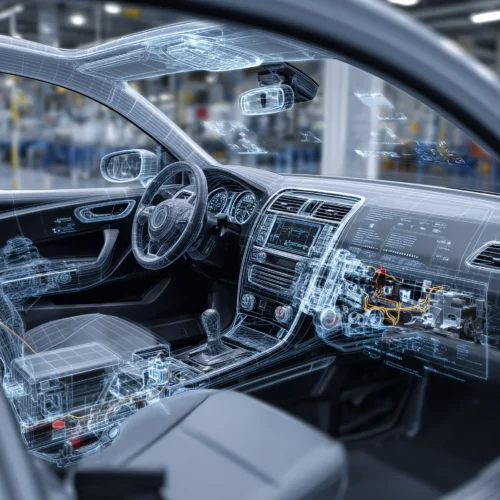
What ADAS Vision does
The system provides a comprehensive and dynamic understanding of the road environment, supporting the driver in critical decision-making. It is capable of:
- Detecting, tracking, and classifying people, vehicles, and road signs in real-time.
- Operating in low-visibility conditions (fog, rain, night).
- Recognizing and interpreting road signage.
- Analyzing and classifying road markings (lane lines, crossings, etc.).
- Identifying and distinguishing between static and dynamic obstacles.
- Segmenting the image into categories: road, people, vehicles, obstacles.
How it works
- Visual Acquisition: Cameras installed on the vehicle continuously capture the road scene.
- Real-time Processing: Neural networks analyze every frame to identify relevant objects and situations.
- Semantic Segmentation: Each element is classified and localized within the visual space.
- Decision Support: Processed data can be integrated into assisted or autonomous driving systems.
Technology
- Neural networks for road object detection and classification.
- On-board real-time processing.
- Robustness in challenging environmental conditions.
- Semantic segmentation for detailed scene understanding.
Benefits
- Safety: Increased awareness of the surrounding environment to prevent accidents.
- Reliability: Stable operation even in adverse weather conditions.
- Precision: Accurate classification of objects and signs.
- Integration: Compatible with ADAS systems and autonomous driving platforms.
ADAS Vision is the ideal choice for automakers, mobility technology providers, and autonomous driving projects.